Out on the trail, electricity has quietly become as essential as coffee and dry socks. Phones handle navigation, headlamps replace campfires, and cameras demand constant feeding. Somewhere between ultralight minimalism and full-blown mobile power stations lies the humble power bank. Choosing the right one isn’t hard, but the specs are written in a dialect designed to confuse exhausted humans. Before you buy something the size of a brick or trust your weekend to a mystery rectangle, it helps to understand what those numbers actually mean.
Capacity: mAh vs Wh
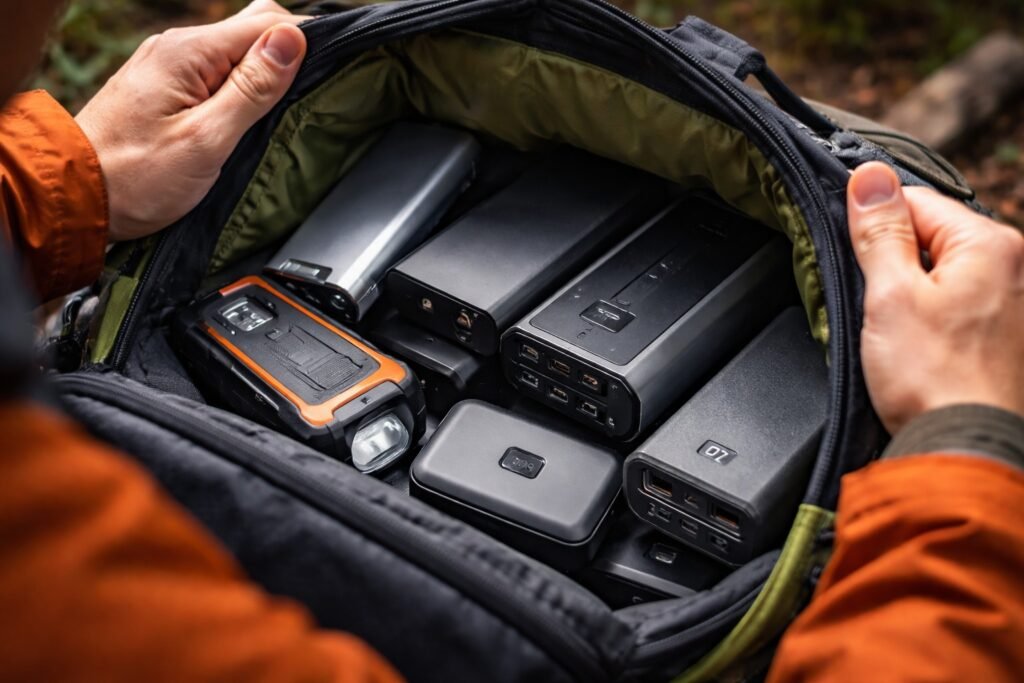
The hype shops plaster mAh everywhere because it sounds big. What it really measures is charge at a fixed internal battery voltage, usually 3.7 V. To compare apples to apples, watt-hours (Wh) is what you care about — that’s actual usable energy. Wh = (mAh × Voltage) ÷ 1000, so a 20,000 mAh pack at 3.7 V is about 74 Wh. (UGREEN US)
Most phones have batteries of around 10–15 Wh. So a 20,000 mAh pack could, in theory, recharge a phone 4–6 times. In reality, you’ll actually get maybe 70–80% of that after conversion losses and cable inefficiencies. (Justin Simoni as: THE LONG RANGER)
If someone throws a gargantuan mAh number at you with no Wh calculation, they’re trading on confusion.
Watt Output (W): Why Your Phone Doesn’t Need 300 W
Watts are how fast the juice can be delivered. A USB phone happily sips at 5–20 W (PD charging), a tablet maybe 30 W, and even power-hungry laptops rarely care about more than 60–100 W. Chargers advertising 200–300 W are for tools, mini fridges, and power tools. You don’t need that to top up a phone or flashlight. For most hikers, 20–65 W per port is more than enough. (NESTOUT)
That’s why you see rugged banks designed mainly for USB devices and modest notebook charging, not monstrous AC outputs. Bigger wattage means more heat, more weight, and a shorter runtime, anyway.
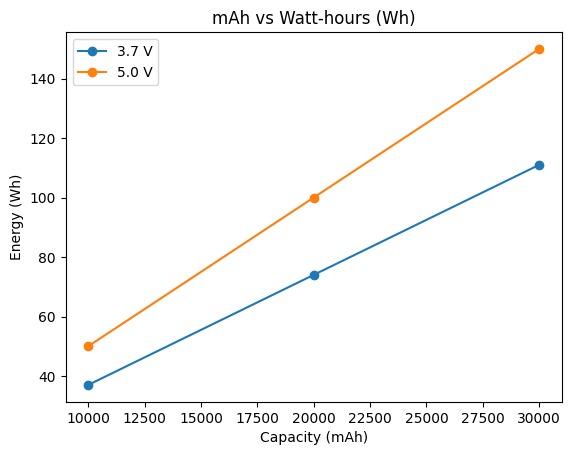
Graphic 1: mAh vs Wh
What it shows
- mAh by itself means almost nothing.
- Wh tells you how much energy is actually stored.
- Voltage is the missing piece everyone ignores.
Key takeaway
Same mAh number + different voltage = very different real capacity.
Example:
- 20,000 mAh at 3.7 V ≈ 74 Wh
- 20,000 mAh at 5 V ≈ 100 Wh
That’s why airlines regulate batteries in Wh, not mAh. Physics doesn’t care about marketing labels.

Graphic 2: Watts, Voltage, and Current
Formula time, but keep it simple:
Watts = Volts × Amps
At a typical USB voltage (5 V):
- 10 W → 2 A
- 20 W → 4 A
- 60 W → 12 A
- 300 W → 60 A
What this actually means
- Higher watts = faster energy delivery.
- Higher watts ≠ more stored energy.
- A 300 W output does not make the battery “bigger”.
Think of it like water:
- Wh = size of the tank
- W = size of the hose
A fire hose drains a bucket faster.
It does not magically make the bucket larger.
IP Rating & Ruggedness
Camping and trails don’t come in a clean, climate-controlled box. An IP rating (e.g., IP65/IP67) indicates how splash- and dustproof a unit is. Dust and rain are real out there. If you’re throwing your pack in a creek crossing or expecting storms, aim for at least IP65. Less rugged models still work, but don’t expect them to survive accidental dunks. (POWEREPUBLIC)
Realistic Use Scenarios
Here’s where things stop being fantasy specs:
Phone Only Trip (2–3 nights)
If you want to use your phone for GPS/Photos/Music/Comms a few times a day, a 20,000–30,000 mAh (≈74–111 Wh) bank will cover it. You’ll likely get 3–5 full charges for a modern phone. Carry one pack like this instead of three tiny ones; fewer cables, fewer headaches. (Reddit)
Phone + Light + Bluetooth Speaker
Assume about 15 Wh for your phone each day, 3–6 Wh for lights, and some extra for accessories. Over a weekend, it adds up to about 50–70 Wh. A 20–30 Wh pack might barely be enough if you’re stingy; a 50–80 Wh pack gives breathing room.
Laptop Somewhere in the Backcountry
If you insist on remote editing or route planning on a big screen, you’ll want something that can sustain ~45–65 W for hours. That’s either a higher-Wh power bank or layering in solar/alternatives.
Temperature and Weather Suck Energy Too
Cold sucks battery capacity. Most lithium packs lose effective capacity below ~50 F (10 C), sometimes dropping 20–30%. Humidity and wet gear can cause circuitry to throttle output to protect itself. So that “80 Wh” on the spec might act like 60 Wh in the real buggy wet cold woods. Stove-warm your pack inside a jacket or sleeping bag overnight; it’s not luxury, it’s pragmatism.
Lifespan and Realities
Power banks aren’t eternal. Good ones will give you 2–4 years of service with everyday use before capacity drops noticeably. Cheap ones crap out sooner. They also don’t hold a perfect charge month to month; keep them at around 50–80% if storing long-term. (Anker)
TL;DR for Campers
- Capacity (Wh) beats flashy mAh numbers for real comparison.
- Watts per port matter only if you’re charging laptops or big gadgets. Phone? 20–30 W is plenty.
- IP ratings and rugged design are worth it if you care about dust, rain, or spills.
- Expect real-world capacity to be ~70–80% of the rated figure, with lower capacity in the cold.
- A good ~20–30 k mAh range covers most weekend excursions without hauling a power station.
If you treat your pack like part of the kit instead of a magic box, you’ll spend less time chasing charging bars and more time actually hiking.

From San Jose, California. Former IT support lead who has seen unspeakable things plugged into USB ports. Reviews electronics with zero patience for bad firmware.