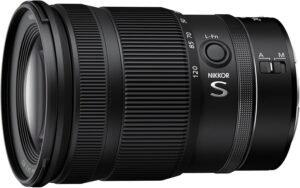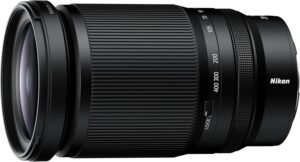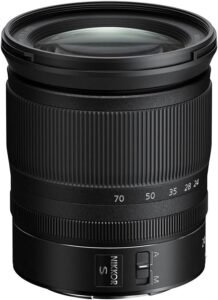
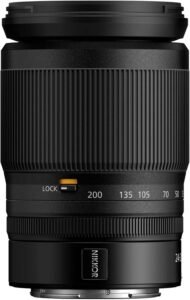
The Nikon NIKKOR Z 24-200mm VR fits a travel-first “one lens, one body” setup for Z series mirrorless cameras. I can cover 24mm landscapes and interiors, then reach 200mm for compressed details and candid street frames without swapping glass. That keeps my pace up and helps me avoid exposing the sensor to dust. I also get strong real-world sharpness, built-in VR for steadier handheld work at longer focal lengths, and video-friendly handling with quiet autofocus plus a clickless control ring. One trade-off stands out, though. I don’t get a physical AF/MF switch, so I have to manage focus mode changes through the camera.
Key takeaways
- 24–200mm all-in-one zoom range supports fast travel shooting from wide scenes to distant details without changing lenses and exposing the sensor to dust
- Sharp, crisp image quality holds up across the zoom range, including solid edge-to-edge clarity for a superzoom and clean rendering in night city scenes
- Built-in VR helps keep handheld shots sharp at the telephoto end and can reduce the need to push ISO, but it doesn’t freeze subject motion
- Compact, carry-friendly build (4.49 x 3.01 x 3.01 inches; 1.26 lb) makes it an easy leave-on lens for street, family, and hike kits
- No physical AF/MF switch means manual focus changes rely on camera controls (buttons/i-menu/custom mapping), which can slow fast switching in the field
All-in-One 24-200mm Zoom Range
The 24–200mm span makes this lens my default “one lens, one body” pick for Nikon Z travel days. I can frame wide landscapes at 24mm, then spin straight to 200mm for compressed city scenes, architectural details, and low-key street candids without swapping glass. That flexibility keeps dust off the sensor and keeps my pace fast.
How I use the range in real shoots
I lean on a few repeatable focal-length habits to stay efficient:
- 24–35mm: Scenic overviews and interiors. I keep edges clean by leveling the horizon and watching verticals.
- 50–85mm: Natural perspective for people and food. I step back a touch to avoid wide-angle facial stretch.
- 105–135mm: Detail layers in landscapes and tighter street scenes. I look for background simplification.
- 200mm: Travel candids and distant patterns. I use higher shutter speeds or stabilize with a railing.
For a lighter everyday alternative, I also like a 24-105mm walkaround zoom, and for extra reach there’s the 400mm telephoto option.
Check current pricing and availability at Amazon here!
Nikon NIKKOR Z 24-200mm VR | Compact all-in-one telephoto zoom lens with image stabilization for Z series mirrorless cameras | Nikon USA Model

This image is property of Amazon.com.
Sharpness and Image Quality
I see sharpness as the headline feature. Images stay crisp across the zoom range, so I don’t hesitate to use it for travel, portraits, or quick wildlife grabs. Edge-to-edge clarity holds up well for a superzoom, and fine textures read clean without looking brittle.
Real-world rendering
For night scenes, point lights keep their shape and don’t smear into mush, which helps cityscapes look polished. I also get consistent contrast and pleasing color, so files need less cleanup. To build a small Z kit around it, I pair it with this wide zoom or a lighter option like this everyday zoom.
Check current pricing and availability at Amazon here!
Nikon NIKKOR Z 24-200mm VR | Compact all-in-one telephoto zoom lens with image stabilization for Z series mirrorless cameras | Nikon USA Model

This image is property of Amazon.com.
Built-In VR Stabilization
Built-in Vibration Reduction (VR) gives me steadier handheld frames, which matters most as I push this zoom toward 200mm. Small shakes get magnified at the long end, and VR helps keep detail crisp without forcing my shutter speed into noisy ISO territory. I treat VR as my safety net for travel days, street scenes, and quick family moments when I don’t want to set up support.
How I use VR in real shooting
I lean on a few habits that keep results consistent:
I keep VR on for handheld stills, especially past ~70mm, then pair it with a good stance and a gentle shutter press.
I still watch subject motion. VR steadies my hands, not a running kid, so I raise shutter speed when action matters.
I disable VR on a solid tripod to avoid stabilization hunting in locked-down shots.
I combine VR with smart lens choices. For lighter walkaround work I’ll grab the 24-105mm everyday zoom, and for ultra-wide interiors I’ll switch to the 14-24mm f/2.8 S.
Check current pricing and availability at Amazon here!
Nikon NIKKOR Z 24-200mm VR | Compact all-in-one telephoto zoom lens with image stabilization for Z series mirrorless cameras | Nikon USA Model

This image is property of Amazon.com.
Travel-Friendly Size and Weight
I like this lens because it stays out of my way in a bag and on a strap. The compact barrel also makes it an easy leave-it-on option, which speeds up street, family, and hike shooting. Nikon lists it at 4.49 x 3.01 x 3.01 inches and 1.26 pounds, so I can plan my carry kit with real numbers instead of guesses.
How I build a grab-and-go kit around it
I keep things simple so I actually bring the camera. A few habits make the size and weight pay off:
- I mount it before leaving and skip swapping lenses in dusty or wet spots.
- I pair it with one small specialist lens if the trip calls for it, like the fast wide-angle zoom.
- I choose a lighter everyday alternative when I know I’ll walk all day, such as the lightweight everyday zoom.
- I go long only when needed; the 400mm telephoto changes the carry equation fast.
Check current pricing and availability at Amazon here!
Nikon NIKKOR Z 24-200mm VR | Compact all-in-one telephoto zoom lens with image stabilization for Z series mirrorless cameras | Nikon USA Model

This image is property of Amazon.com.
Video-Ready Autofocus and Control Ring
I count on the NIKKOR Z 24-200mm for video because its autofocus reacts fast yet stays smooth. The focus motor runs quietly, so I don’t end up recording distracting lens noise. Subject tracking also feels confident for walk-and-talk clips, quick B-roll, and casual gimbal shots where I can’t babysit focus.
Silent control with the clickless ring
I set the customizable control ring for changes I need mid-take, since it turns without clicks and won’t ruin audio. I like a simple setup, so I typically map it to one of these:
- Aperture for gentle exposure shifts while keeping shutter consistent
- ISO for quick corrections when lighting changes fast
- Exposure compensation for subtle tweaks without breaking the shot
- Manual focus override for precise pulls on static scenes
How I pair it with other Z zooms
For wider establishing shots, I swap to the 14-24mm f/2.8 S or the lighter 17-28mm f/2.8. For an everyday range with a simpler feel, I grab the Z 24-105mm. On DX bodies, I keep a compact option like the DX 16-50mm VR.
Check current pricing and availability at Amazon here!
Nikon NIKKOR Z 24-200mm VR | Compact all-in-one telephoto zoom lens with image stabilization for Z series mirrorless cameras | Nikon USA Model
This image is property of Amazon.com.
Optics and Coatings
Glass choice and surface treatments shape how the NIKKOR Z 24-200mm renders contrast, handles backlight, and stays easy to maintain. I lean on its aspherical elements to rein in distortion and keep edges cleaner, especially at wider focal lengths where straight lines can bend fast. ED glass does the heavy lifting on color fringing, so high-contrast edges like branches against bright sky look tighter and require less correction later.
How I put the coatings to work
In real shooting, coatings matter most when light hits the front element at bad angles. Here’s how I treat the key layers in practice:
- ARNEO Coat helps suppress flare and ghosting when I shoot into bright sources, so blacks don’t wash out as quickly.
- The fluorine coat makes smudges and water spots less clingy, so I can wipe the front element quickly without grinding grit across the glass.
- I still use a hood when possible, because coatings reduce artifacts but don’t replace good shading.
If I want a lighter everyday alternative, I reference the 24-105mm everyday zoom. For wider scenes, I compare with the 14-24mm f/2.8 S.
Check current pricing and availability at Amazon here!
Nikon NIKKOR Z 24-200mm VR | Compact all-in-one telephoto zoom lens with image stabilization for Z series mirrorless cameras | Nikon USA Model

This image is property of Amazon.com.
Usability Note: No Manual Focus Switch
Autofocus feels quick and confident on this lens, but I keep one practical quirk in mind: it has no physical AF/MF switch. That means I can’t flip a lever by feel when I need manual focus fast. Instead, I switch focus modes through the camera’s buttons, the i-menu, or assigned custom controls. That workflow works fine once I set it up, yet it can slow me down when I’m shooting street scenes, low-contrast subjects, or video pulls.
How I work around it in the field
I rely on a few habits to keep focus changes smooth and predictable:
- I map AF/MF (or Focus mode) to a function button so I can change modes without taking my eye from the finder.
- I pin Focus mode and AF-area mode to the i-menu for quick access when I don’t want extra button assignments.
- I use focus peaking for manual tweaks, especially with backlit subjects or fine detail.
- I practice switching modes before critical shoots so it becomes muscle memory.
For sessions where I want simpler handling, I sometimes pack an everyday zoom like the NIKKOR Z 24-105mm or go wider with the Z 17-28mm f/2.8.
Check current pricing and availability at Amazon here!
Disclosure: As an Amazon Associate, I earn from qualifying purchases.

I’m a computer engineer, musician, cyclist, and dabbling in photography.